
The Case for Term Limits
restoring accountability to American politics

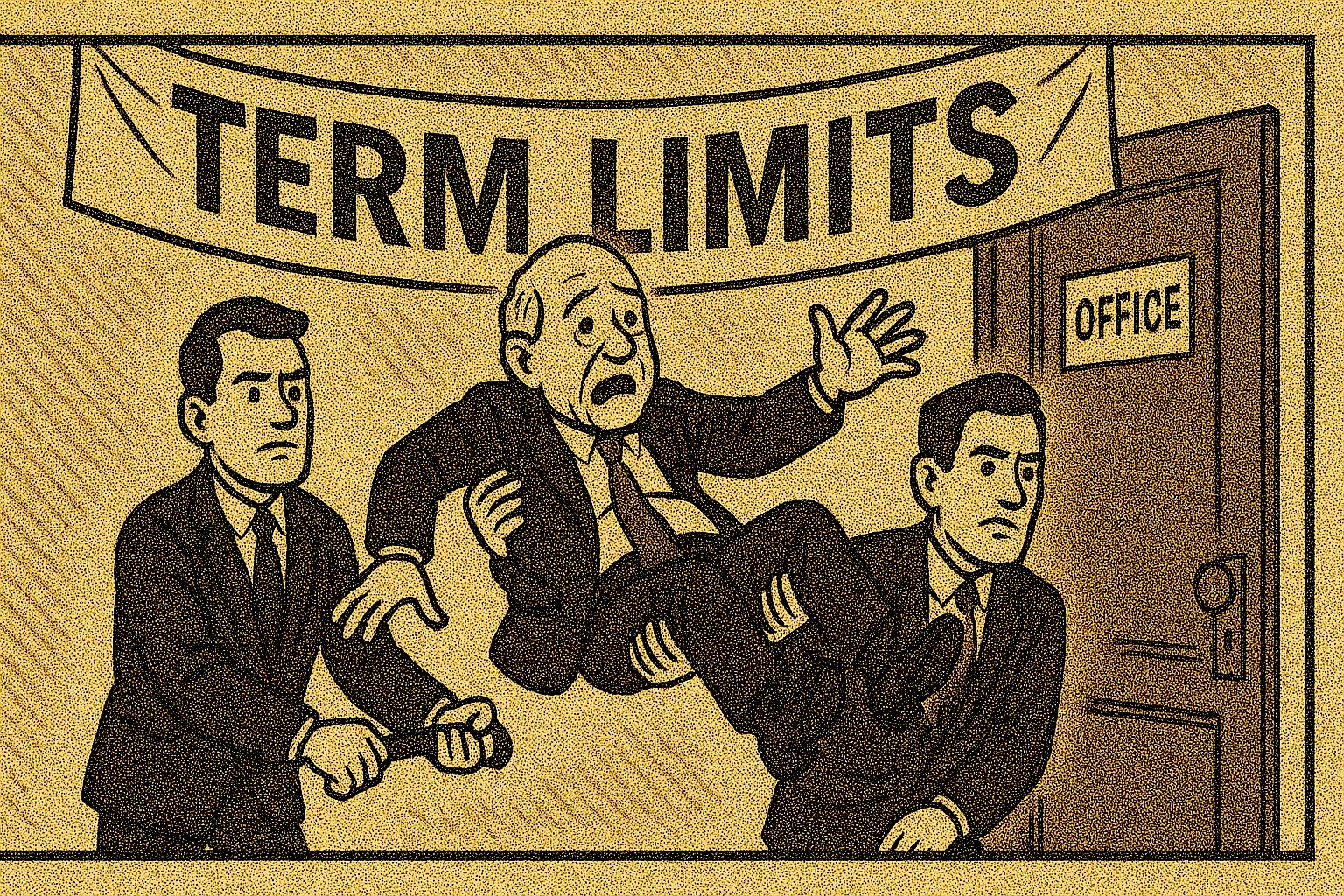
There was a time when public service was just that—a service. Men and women stepped into office for a season, contributed their experience and judgment, and then returned to private life. That was the ideal of the citizen-statesman the Founders had in mind. Today, however, politics has become a profession—a career path insulated from the consequences of failure, where incumbency too often trumps competence, and where elections are more about name recognition than ideas. It is precisely this disconnect that makes the case for term limits compelling to the concept of representative government.
The power of incumbency in American politics cannot be overstated. Once elected, members of Congress enjoy taxpayer-funded staffs, franking privileges, and a constant platform to communicate with constituents at public expense. They benefit from name recognition that challengers cannot hope to match without massive financial backing. The result is a re-election rate that would make autocrats blush.
In 2022, for instance, over 94% of House incumbents who sought re-election won. Yet few Americans believe Congress is doing a stellar job—approval ratings routinely hover below 25%. How is it that an institution so widely distrusted continues to reproduce itself almost without change? The answer is that the system, as it stands, rewards permanence, not performance.
Lord Acton’s famous warning that “power tends to corrupt, and absolute power corrupts absolutely” was not meant for kings alone. It applies equally to legislators who, over time, come to see their offices not as trusts but as entitlements. The longer a politician stays in office, the more his survival depends on the machinery of politics rather than the consent of the governed.
Term limits, by design, would break this cycle. They would remind elected officials that their authority is temporary and conditional—not a lifetime appointment but a lease on trust that must eventually expire. When politicians know that their time is finite, they are more likely to focus on governing rather than campaigning, on serving rather than surviving.
The Founding Fathers did not include formal term limits in the Constitution for Congress, but they hardly envisioned a permanent political class. Public office, they believed, was a duty—something one should return from, not cling to. George Washington set the precedent by stepping down after two terms as president, warning against the “spirit of domination” that comes with extended tenure.
Critics of term limits argue that experience in office produces better governance. But experience is not the same as wisdom. Long-serving politicians become experts in the ways of bureaucracy, not the needs of citizens. They learn how to manipulate rules, curry favor, and shield themselves from accountability.
If experience was the key to good government, Washington would be a model of efficiency and virtue. Instead, it has become a swamp precisely because the same people keep wading through it decade after decade. The notion that those steeped in the system will reform it is the kind of circular reasoning that keeps Washington in perpetual dysfunction.
In economics, monopolies stifle innovation because they eliminate the pressure to compete. The same logic applies to politics. A political monopoly—one held by incumbents and entrenched party leaders—reduces competition of ideas. Without turnover, there’s little incentive to innovate policy or challenge failed orthodoxy.
Term limits would introduce competition by forcing renewal. They would create an ongoing flow of new voices, new expertise, and new accountability. Just as free markets depend on creative destruction, democracy depends on political renewal. The absence of both leads to stagnation, inefficiency, and corruption.
Term limits would force politicians to live again as citizens—subject to the laws and policies they create. That, in itself, would be a powerful deterrent to bad policy. It’s easy to pass burdensome regulation when you’ll never have to face it outside the halls of power. It’s harder when you know you’ll soon be back in the real world, navigating the same red tape you once wrote.
Naturally, the loudest opposition to term limits comes from those who would be most affected by them. Politicians invoke “the will of the people,” arguing that voters already have the power to remove them. But this argument ignores the structural advantages of incumbency and the barriers to meaningful competition. To say voters can “just vote them out” is like telling consumers unhappy with their phone company to “just start their own.”
In truth, the entrenched political class resists term limits for the same reason monopolies resist free markets: they prefer comfort to competition. The purpose of term limits is not to punish politicians but to restore the balance of power between the governed and their governors.
America’s founders designed a republic, not a career ladder. They understood that liberty depends on diffusion of power, not its concentration.
Term limits are not a cure-all, but they are a corrective—a way to return politics to its original purpose. They remind us that no one is indispensable, that government exists to serve, not to rule. More importantly, they reaffirm a truth that should never have been forgotten: in a free society, public office is not a lifetime possession, but a temporary trust, lent by the people and reclaimed in their name.
OUR USA GOVT., QUIT BABYING OTHER COUNTRIES THAT BACK STAB US SO YOU CAN HELP AMERICAN VETERANS / SENIOR / DISABLED CITIZENS THAT THE DEMONICRATS BACKSTABBED,,,, TRUTHFUL FACTS. --- MANIPULATION OF OUR USCONSTITUTION BY EVIL socialism, jihad, atheism, marxism, communism and other Evil Sources of anti AMERICANISM IN OUR ONE NATION UNDER GOD WILL BE DESTROYED. --- OK AMERICA WE DONT PAY TAXES TO Izlamik Socialist Communists or any of their SUBSIDIARIED RELATIONS IN OUR ONE NATION UNDER GOD. --- WHEN YOU DONT SWEAR IN WITH YOUR HAND ON THE HOLY BIBLE THATS TREASONOUS jihad. 🇺🇸 🙏 💪 WE ARE ONE NATION UNDER GOD, UNITE